How do sunglass lenses work? A complete guide to help you choose the right sunglasses
More than a fashion accessory, sunglasses play an essential role in protecting your eye health.
They protect your eyes from UV rays, reduce glare, and improve everyday visual comfort.
To choose the right sunglasses, it is important to understand the different solar lens technologies, their materials, their UV filtration capacity, and their specific treatments.
I am Mathilde, the Founder of Malen Square. I was trained and graduated from the Institut Supérieur d’Optique, and I am going to explain how to understand solar lens categories!
HOW TO CHOOSE THE RIGHT CATEGORY OF SOLAR LENSES?
There are three lens parameters to consider when purchasing your sunglasses:
· The material that provides UV filtration
· The tint of the lens that helps reduce glare
· Additional treatments that improve visual quality.
1-THE MATERIAL, ORGANIC OR MINERAL LENSES: WHICH ONE TO CHOOSE?
The lens material is the first element to analyze to understand the protection your sunglasses provide, since it is the material that filters UV rays!
Thus, even with a pair of prescription glasses, you are protected from UV rays!
There are two main families of materials used to make lenses: organic lenses (made from synthetic materials) and mineral lenses (made from mineral glass).
-
ORGANIC LENSES:
Organic lenses are made from plastic or polymer, making them twice as light as mineral lenses and thus providing better long-term comfort. Indeed, organic lenses are known to be extremely impact-resistant because they are very flexible.
Lightweight and resistant are two important criteria for satisfying glasses wearers. This is why they are found in 99% of the sunglasses offered on the market.
They offer very good optical quality, measured by chromatic dispersion (colored fringes at the edges of the lenses), which is measured in Abbe number. The higher the Abbe number, the fewer chromatic aberrations there are. Organic lenses have an Abbe number of 58, placing them at a very, very good level of optical quality.
Today, they are the first choice for sun-exposed athletes who want lightweight and resistant equipment, but also for users looking for lightweight, resistant, and comfortable sunglasses.
Given their resistance and flexibility, they can benefit from all types of treatments to adapt to needs. Being highly sought after by the sports market, organic lenses can easily receive treatments such as polarization, anti-reflective coatings, specific colorations, and more...
The particularity of organic lenses is that they filter UV rays extremely well. Some organic materials filter 100% of UVA and UVB rays, thus meeting the UV400 standard.

There are variations of organic lenses, one of which is quite well known: polycarbonate lenses. These lenses are almost unbreakable; in fact, they are 200 to 250 times more resistant than organic lenses, in addition to being twice as light. They are therefore ideal for children as well as athletes. Polycarbonate lenses offer 100% UV protection and have good optical quality, but it is inferior to other organic materials, which is why they are used less.
Despite their great resistance, because organic lenses are more flexible, they remain sensitive to scratches without hardening treatments.
-
MINERAL LENSES:
Mineral lenses are traditional (natural) lenses that remain the benchmark for optical quality. Mineral lenses are made from silica and have historically been the benchmark material in optics for their exceptional visual quality. They are the "real glass" as we know it.
Weighing twice as much as organic lenses, they are used less than the latter, but they provide greater natural scratch resistance and better visual quality (58 to 60 in Abbe number). They offer a "purer" or sharper visual sensation. They have highly effective UV filtration (up to 85%, but this is still lower than organic lenses). This is why they are often equipped with surface treatments that improve these ratios.
As mentioned, they are heavier than organic lenses, so they are used less today, but they can be found on certain iconic Ray-Ban models, such as the Aviator, for example. This choice can also be favored for wearers who need the best possible visual quality, such as athletes who practice archery, for example.
Despite these advantages, these lenses have weaker impact resistance and are therefore prohibited for children.

2-TINT: WHAT IS THE DIFFERENCE BETWEEN UV PROTECTION AND LENS CATEGORY?
The tint of the lenses protects the eyes from brightness, unlike the material, which filters UV rays. The tint directly contributes to visual comfort. We are talking about light transmission. The perception of brightness differs depending on whether you have sensitive eyes or not.

Be careful, the tint reduces visual acuity, which is why we are bothered by sunglasses indoors. It is therefore important to find the right tint depending on how you want to use them.
-
THE DIFFERENT TINT CATEGORIES
There are five filtration categories, ranging from 0 to 4. They correspond to the amount of visible light filtered (not UV protection).
Category 0:
- Lets 100% of the brightness through, clear lenses
- These are very light or clear lenses (to choose from)
Category 0 is ideal for low-light conditions, overcast skies, indoor sports, or for your prescription glasses!
Category 1:
- Lets 60% of the brightness through, low sun protection
- These are very light lenses
Category 1 is ideal for adding style to glasses, as light tints are very trendy. It can also be used indoors for certain sports.
Category 2 :
- Lets 30% of the brightness through, medium sun protection
- These are lenses where you can see the tint, and it starts to become hindering indoors. Category 2 is used in medium brightness, in the city, in mid-season. It can be found on the lower part of gradient lenses, which are often very trendy.
Category 3 :
- Lets 15% of the brightness through, high sun protection
- This is the most common tinted lens.
Category 3 is versatile, used in strong sun both at sea and in the mountains, at the beach or in the city. This category is found on most sunglasses. Eyewear Houses or Haute Couture Houses favor this category on most of their collections.
Category 4 :
- Lets 5% of the brightness through, extreme sun protection
- Very dark lenses
It is prohibited for driving and is used in very strong brightness, such as in high mountains, on glaciers, or for sailors at sea; It is required for very specific uses. The Brands offering this category are rare, we find very sports-oriented brands, especially mountain sports: Maui Jim, Oakley, Julbo, Demetz, Vuarnet…
Category 3 is found on a large majority of premium sunglasses and luxury glasses, thanks to its versatility and excellent level of visual comfort.
-
SOLID LENSES OR GRADIENT LENSES?
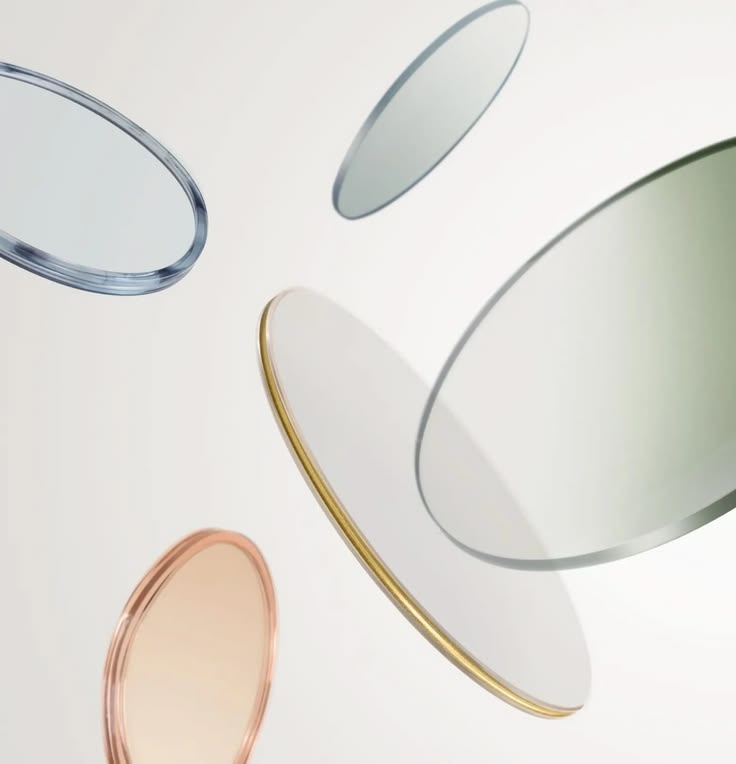
The lens coloration can vary from top to bottom; this is a gradient lens. When the tint is uniform across the entire lens, it is a solid lens.

Solid lenses have a uniform tint as well as homogeneous protection. They are recommended for people sensitive to light, unlike gradient lenses, which make reading at the bottom of the lens and everyday activities easier.
Gradient lenses are particularly present in luxury sunglasses collections for women and men, bringing an important element to aesthetics and comfort.
Several coloring processes are used;
- Coloration in the bulk of the material
- Layer on the surface of the lens
-
WHAT LENS COLOR TO CHOOSE?
Beyond aesthetics, the color of solar lenses influences visual comfort, visual perception, especially contrasts, and quality of vision depending on the environments.
Gray: naturally respects colors, uniformly reduces brightness, and is perfectly suited for versatile everyday use: driving, the sea, the mountains...
Brown/Maroon: it is also very well suited for versatile everyday use and has the particularity of enhancing contrasts, especially on reflective surfaces. It improves the perception of relief, sharpness of features, and is adapted for sports / outdoor activities as well as driving. Many ski masks are offered with brown visors improving the perception of relief when the weather is overcast.
Green: it is also very well suited for versatile everyday use and has a good balance between contrast and color fidelity in addition to reducing visual fatigue.
Yellow / Orange: this color increases contrast during low brightness (fog, cloudy weather, …). Thus many ski masks offer yellow visors ideal during foggy weather. The visual difference with this color is quite impressive. You find this tint on driving glasses since it has a vision improvement effect.
Pink / Red: these colors accentuate contrasts and are ideal for outdoor sports. They also offer an improvement in colors as well as exceptional clarity.
Blue : blue is more often sought for aesthetic purposes. Some models still allow reducing glare and offer better visual comfort as well as better adaptability to brightness variations
Copper / Amber: these colors have the particularity of improving depth perception especially during activities like driving or even golf.
-
THE ADVANTAGES OF PHOTOCHROMIC LENSES:
Photochromic lens is a variable tint lens. That is to say that its tint intensifies when it is in contact with the sun, going from category 0 to 3 for example. There are several tint variations and several colors.
The advantages of a pair of photochromic glasses are that it guarantees complete protection against UV rays and that it adapts to the environment whether in rainy weather, sunny weather, dark places or much brighter ones.
Although photochromic lens has a transition time of 5 to 10 seconds, you have to wait about 2 min for it to readapt after your exposure to the sun depending on the temperature of the lenses.
3-ADDITIONAL LENS TREATMENTS: WHAT IS THE ADVANTAGE OF POLARIZED LENSES?
-
POLARIZED LENS:
The polarized lens incorporates a specific filter allowing to remove light reflection phenomena and significantly improve the quality of vision. It allows to eliminate the "bouncing" glare from flat surfaces such as snow, water, grass, wet roads, a car hood …
Its particularity is to provide better visual comfort, reduce eye fatigue, bring improved contrasts and more readable colors.
Polarized sunglasses are particularly adapted to driving, outdoor sports especially on the water, and high-end everyday use.
-
INTERNAL FACE ANTI-REFLECTIVE:
The internal face anti-reflective is a filter that reduces reflections on the back of the lens in contact with the eye. It allows the eye to receive less radiation coming from the back of the glasses. It thus improves sharpness and reduces visual fatigue. It is particularly useful for very flat lenses.
FAQ:
>What category of sunglasses for driving?
For driving during the day, favor category 2 or 3 sunglasses. Category 3 is the most used because it offers an excellent compromise between protection against glare and visual comfort. Category 4 lenses are prohibited for driving.
>Do lens categories protect against UV?
No. The category of a solar lens indicates the amount of visible light filtered. The protection against UV rays depends mainly on the lens material and its compliance with the UV400 standard.
>What category to choose for the mountains?
For mountain activities, category 3 is generally recommended. In high mountains or on glaciers, where the reflection of the sun on the snow is particularly intense, category 4 is preferable.
>Do polarized lenses protect better against UV?
No. Polarized lenses do not increase the protection against UV rays. Their role is to remove annoying reflections on reflective surfaces like water, snow or wet roads in order to improve visual comfort and the perception of contrasts.
>What difference between polarized lenses and photochromic lenses?
Polarized lenses and photochromic lenses meet two different needs. Polarized lens reduces reflections and glare to improve visual comfort. Photochromic lens automatically adapts its tint depending on the intensity of UV and outdoor brightness.
>What lens to choose if I have sensitive eyes?
If you have light eyes or particularly sensitive to light, favor category 3 sunglasses. This category offers excellent protection against glare and is suitable for the majority of everyday situations, in the city as well as at the beach or in the mountains.
>Do category 3 sunglasses protect against UV?
Yes, provided that the lenses comply with the UV400 standard. Category 3 only indicates the level of visible light filtration. The protection against UVA and UVB rays depends on the lens material and its capacity to filter UV rays.
>What does the UV400 mention mean on a pair of sunglasses?
The UV400 mention means that the lenses filter 100% of UVA and UVB rays up to 400 nanometers. It is today the recommended level of protection for quality sunglasses.
>How can you tell if a pair of sunglasses really protects against UV rays?
To check that a pair of sunglasses effectively protects against UV rays, several markings should be present inside the temples:
• The CE marking, which certifies compliance with European standards.
• The lens category (from 0 to 4), which indicates the level of visible light filtration.
• Information about the manufacturer or brand, ensuring product traceability, particularly the serial number.
When you buy your glasses from an optician or an official brand retailer, you benefit from full product traceability and the assurance that the lenses meet current standards.
At Malen Square, all sunglasses are sourced directly from the brands sold on the website. Each model is authentic, traceable, and supplied with the documents provided by the brand, as well as, where applicable, certificates or cards of authenticity.